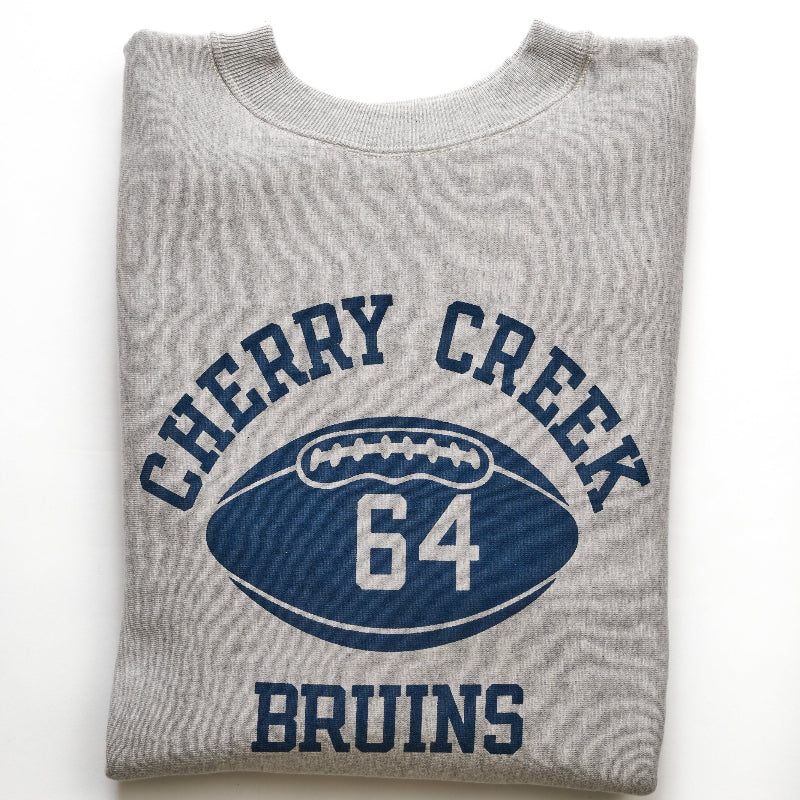
When you pick up this sweatshirt, the first thing that will strike you is its "heaviness."
This newly developed sweatshirt was created through repeated trial and error to recreate the RW type of the 1960s. This innovative athletic sweatshirt uses cross-grain fabric to reduce shrinkage, and while its side panels often catch the eye, its true character lies in the "yarn."
Knitted with an extremely dense stitch, the fabric is firm yet elastic, heavy yet softly supple.
And what Warehouse is particularly particular about is the fabric's "grain." In standard sweatshirts, a prominent fabric grain usually appears as "vertical ribs," but in this RW model, it appears as "horizontal ribs."
To make the grain stand out, we repeatedly changed combinations such as the yarn count and the density of the knit. What we eventually arrived at was "pull-in" knitting, which is rare for sweatshirts.
While standard sweatshirts are usually knitted by combining one yarn for the face, middle, and back, using pull-in knitting made it easier to increase the stitch density. Furthermore, thanks to the characteristics of the loop knitting machine, we were able to make the fabric firm while maintaining its elasticity and making the surface grain stand out.
It is said that with sinker knitting machines, which were adopted later in history, even when using the same yarn specifications, the fabric becomes too stiff, and the difference in the finished knit is stark.
The "heaviness" of the finished fabric requires skilled workmanship during both dyeing and sewing. It places more strain than usual during dyeing, and sewing is no easier than with lightweight knitwear.
The "weight" of this RW-type sweatshirt is the result of a collaborative "relay" across every process: fabric production, dyeing, and sewing.
We will also explain the origins of this RW model below.
Remarkably, when the torn sections of vintage 1960s fabric commonly known as "tatami tags" were analyzed, pull-in yarns were found exposed.
The spirit of the pioneers, who attempted to develop athletic wear in a pastoral yet uncompromising manner, is unearthed through this "relentless pursuit of detail."
・Reverse-style loop-back terry
▶You can see images of the product worn by WH TIMES.
■Size Chart Unit: cm
| Size |
Length (L) |
Shoulder Width (W) |
Chest Width (C) |
Sleeve Length (S) |
| S |
62 |
40 |
55 |
63.5 |
| M |
64 |
43 |
57 |
64.5 |
| L |
66 |
47 |
59 |
66 |
| XL |
67 |
49 |
62 |
67 |
(L) Body Length Back , (W) Shoulder Width , (C) Chest , (S) Sleeve Length
※The above measurements are for the unwashed garment.
※The following shrinkage will occur after washing.
Length (L): approx. 1 cm Shoulder Width (W): approx. 1 cm Chest Width (C): approx. 2 cm Sleeve Length (S): approx. 1 cm
※Shrinkage may vary depending on the washing method and individual differences.
■Size Chart Unit: cm
| Size |
Length (L) |
Shoulder Width (W) |
Chest Width (C) |
Sleeve Length (S) |
| S |
64 |
41 |
54 |
63 |
| M |
66 |
44 |
58 |
66 |
| L |
68 |
46 |
60 |
68 |
| XL |
71 |
49 |
63 |
69 |
(L) Body Length Back , (W) Shoulder Width , (C) Chest , (S) Sleeve Length
※The above measurements are for the unwashed garment.
※The following shrinkage will occur after washing.
Length (L): approx. 2–3 cm Shoulder Width (W): approx. 1 cm Chest Width (C): approx. 3–4 cm Sleeve Length (S): approx. 2–3 cm
※Shrinkage may vary depending on the washing method and individual differences.
Measurement Locations